


Before.
I fantasized about letting my gold 2002 Nissan Sentra drift across the double yellow lines of Laurel Canyon Boulevard.
A cute little collision was all I wanted—nothing fatal or disfiguring—just enough to send me to the hospital so I could get a good nap.
My big dream of becoming the next Katie Couric had disintegrated into me working the overnight shift writing scripts for local news anchors so they could live their dreams.
Then, I got an email: “Any chance you wanna work for Princess Leia?”
The mission.
A friend worked for Carrie Fisher’s agent.
The Star Wars icon needed a new assistant and I checked a few boxes.
Her team wanted someone gay because apparently Carrie could be, ahem, amorous. And they wanted a writer who could help her with her books and theatre work.
I drove my good old Sentra to her mansion.
She needed help.
I needed a hero.
You know what?
I like this.

Hi. I’m Byron.
Never miss my column.
Join 700+ other subscribers.
Free.
Never junk.
A Substack Bestseller.
What people say.
“Life got ya down? Convert to Byrontology! Sharp writing + poignant insights + Carrie Fisher stories. What’s not to love?”
—Dan Hass, SOS: Satire or Something
“Byron Lane has one of my favorite brains on the planet. I love his brand of humor and storytelling. I always learn something from the Study of Byron!”
—Evan Roberts, Don’t Be Precious, Darling
“Every post from Byron feels like getting a message from the funniest person in the group chat … and that person also happens to be an extraordinary writer.”
—Maggie Downs, Be Back by Dinner
The mansion.
I was sweating as the gates opened to Carrie’s Beverly Hills estate.
I parked my Nissan next to a new BMW and a new Lexus.
Nearby, a big green Cadillac was parked in a carport under a vintage neon sign that said “Debbie’s Diner.” As in Debbie Reynolds. She and Carrie lived in neighboring homes on the same lush lot.
A brick path on rolling hills led me to Carrie’s mansion, a one-hundred-year-old hacienda-style work of art.
A sign read, “clothing optional beyond this point.”
A tennis court to my right had a giant plastic cow standing on it.
A guest house to my left had a sign on the door that read, “In hell from sex.”
A crystal chandelier hung from a giant oak tree. (Later, Carrie said it was Russian. She said it was a gift from Meryl. As in Meryl Streep.)
The apparition.
Onto the front porch. Up to her front door. I knocked. And—
A housekeeper let me into wonderland.
A deconstructed chandelier—little pieces of shimmering glass—was spread apart on an almost invisible net hung from the ceiling.
The head of a giant moose lived above a raging fireplace.
I sat in an old leather chair atop the thick wood slabs of her floor—the kind of floor they don’t make anymore, the kind you can’t get from Home Depot. (Later, she said her floors were made of endangered trees.)
Wait! There! Was that—
Carrie was running in circles in her backyard. Through the warped panes of her antique French doors, she looked more spirit than human.
This apparition, her hands were full of papers, some of them flying up and around her like she was the center of a hurricane. She vanished.
The interview.
A flash caught my eye to the right of the fireplace. The moose gave me a worried look. Through a thick puff of cigarette smoke, she emerged.
Carrie Fisher was radiant, electric, otherworldly. Katie Couric could never.
I was advised not to mention Star Wars—try to be cool, I was told. So when my chat with Carrie was over, in case I never saw her again, I wanted to tell her I appreciated her work.
I told her I loved her appearance in a small cult film called Drop Dead Fred.
She stared at me, cocked her head, suspicious. “Was I in that?” she asked. (She was.)
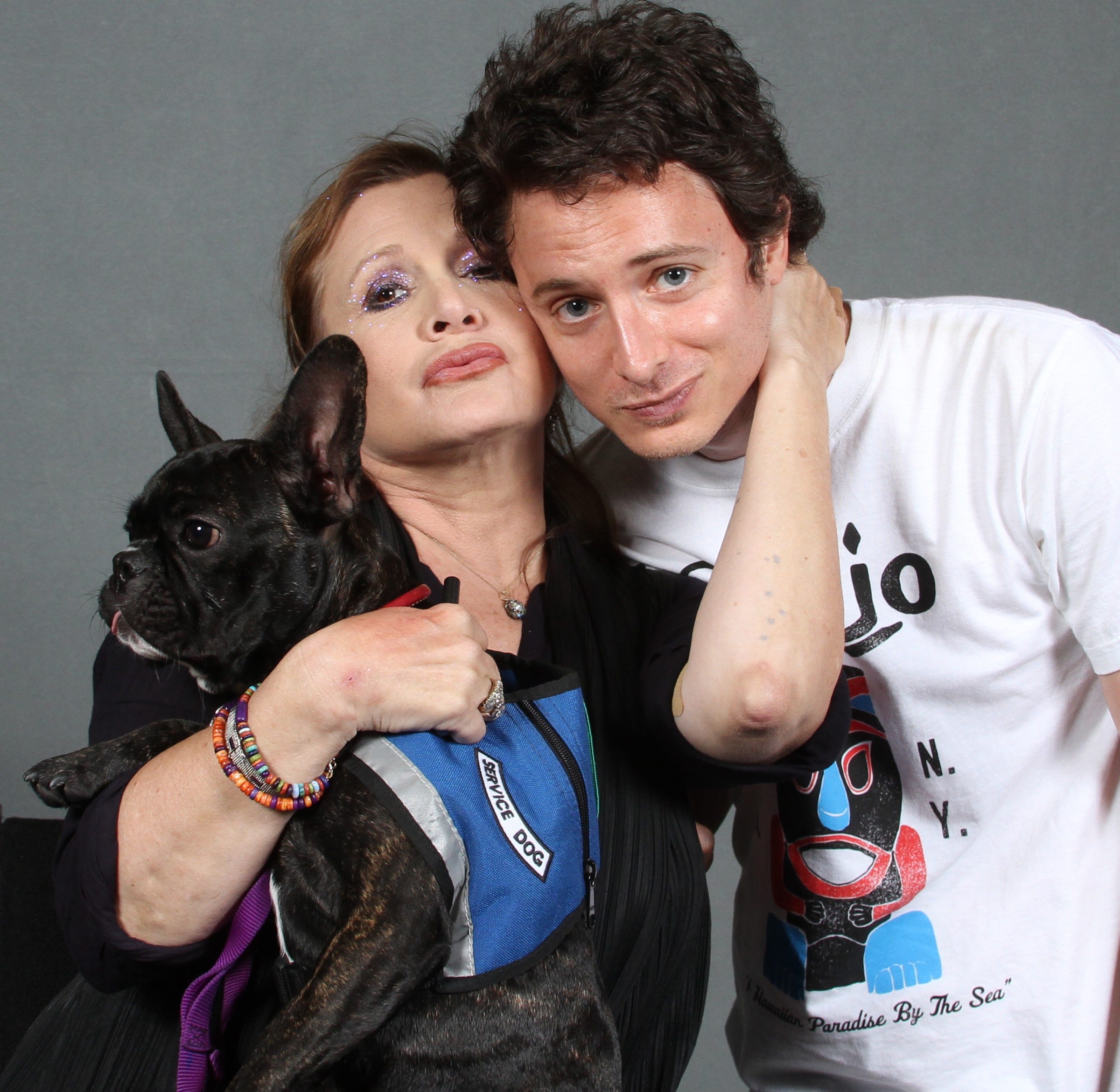
Parenting.
Later, Carrie would tell me I got the job because I was “groovy.” I’ve not been called that before or since.
Being a celebrity assistant was like having a kid. Suddenly, you’re completely in charge of someone else. You know every preference and password. You wake them in the morning. You worry—has she slept, eaten, peed? How’s her hair? Her clothes? Will the other kids make fun of her on TMZ?
The care quickly turns to love because, like parenting, no one stays in these relationships for the pay and perks alone.
Healing.
Carrie Fisher was a healer. A friend of hers was having trouble with his teenage daughters, so she invited them all to her mansion, to her bedroom, and they sat on her bed and hashed it out. She guided them home to each other—a star leading others to their mark.
This kind of thing happened all the time—counseling limo drivers, fans at autograph conventions, fellow actors on set, and me.
She and I talked about tensions with my dad. She kept her dead father’s dentures in a coffee mug labeled “World’s Best Dad” in a mini-fridge in her guest house. She said it’s sometimes easier to love family from a healthy distance.
We traveled the world. It was in Bali where we accidentally almost had a couples massage. We got kicked off a gay cruise in Aruba (she was a guest performer but had medical complications). She got a weather alert that the northern lights were going to be spectacular in Canada the next day and asked me to immediately book a flight for us. We went dog-sledding during the day—she drove. And we saw the lights at night. Magical. Freezing.
I didn’t own a proper winter coat. She bought one for me.


The job.
I yelled at paparazzi for her. I sorted her daily meds. I held her jewelry during her electroshock treatments for bipolar disorder, and she held my hand as I drove her home afterward. Some days, I wished a little of that electricity would jolt into me—just enough to lighten my own depression, which had started rearing its head again.
For three years, I had the best life, but it wasn’t mine.

The complication.
I was living Carrie’s life, enjoying her home, her friends, her holiday parties. I was a supporting character in someone else’s story. Yes, it was fucking cool. But it was not always easy. And when I say it was a full-time job, I mean full. There was not time or space for anything but my “child,” my movie star, my hero.
Then, I met someone.

I’ll kill you.
I quickly fell in love with Steven. As in Steven Rowley, my now husband. But I wasn’t available when we first met. Not really. I was in a relationship with Carrie.
Steven was incredible about it. And Carrie was cool, too. At a party at Penny Marshall’s house she pulled him down by his lapels to whisper in his ear, “If you hurt him, I’ll kill you.”
Carrie was thrilled about the new Star Wars movies—move to London! More parties! More living!
But it was more of her living. I’d have to go with her overseas. I’d be even farther from my life, and from Steven. I felt like I had to choose: Do I keep living her life or start living my own?
The ending.
I knew if I quit the job, I would have eternal regrets. But not as big as the regret I’d feel if I didn’t try to live my own life fully, to really give it my best shot, to pursue my dreams, my story, not be a footnote in someone else’s.
Turns out a little of Carrie’s electricity must have flowed into me after all, a dose of her clarity and rebel spirit.
Princess Leia and I said goodbye. We remained friends, but I stopped being her assistant. The last walk across those endangered floors was brutal, heartbreaking. She was hurt, didn’t fully understand. And I was torn—was the grass really greener outside her gates?
I never again had a job that cool.
She died a couple years after I left.
In grief, I turned to her advice, what she told me and others when we were down: “Take your broken heart and go make art.”
I had two broken hearts. First, me leaving Carrie. And then, Carrie leaving all of us.
I wrote a novel about my time with Carrie, what she taught me, how she saved me. And that was my first book, called A Star Is Bored.
Turns out, she never stopped holding my hand.



You know what?
I like this.

Hi. I’m Byron.
Never miss my column.
Join 700+ other subscribers.
Free.
Never junk.
A Substack Bestseller.
What people say.
“Life got ya down? Convert to Byrontology! Sharp writing + poignant insights + Carrie Fisher stories. What’s not to love?”
—Dan Hass, SOS: Satire or Something
“Byron Lane has one of my favorite brains on the planet. I love his brand of humor and storytelling. I always learn something from the Study of Byron!”
—Evan Roberts, Don’t Be Precious, Darling
“Every post from Byron feels like getting a message from the funniest person in the group chat … and that person also happens to be an extraordinary writer.”
—Maggie Downs, Be Back by Dinner


My heart still hurts. The pain is five years old + and I am just now learning to live with it. Steven heard the pain and made art, which healed me with humor and good memories, even if for just a few paragraphs. Now I find myself at a career crossroads wondering is it my story I am living? Or is it a story of expectations that no longer serve me? This post gave me some clarity that I hope to put to good use.
Art certainly has been my healing modality, but I always encountered people saying, “tell your story.” And in some ways, my art was a filtered version of my story made more palatable. The feelings were there and raw, what was I missing? Was I too surface level? Or did people just not get me? Too weird?
Then I wrote something a little more real to my experience and it scared me when what I wrote started showing up in my life, sometimes verbatim. What kinda power is that?! And a little more success, though it still seems like a bridge to something greater just beyond, I’m not sure I’ll ever truly know myself enough to see it.